
Updated August 31, 2026. A Bitcoin miner space heater is not a different kind of machine. It is a Bitcoin miner whose heat is deliberately used instead of dumped into the wrong room. This guide explains the physics, operating cost, electrical limits, airflow choices, and practical differences between an Antminer S9 heater build, a 140W Canaan Nano 3S, and an Avalon Q running from 800W to 1,674W.
Quick answer
Can a Bitcoin miner really heat a room?
Yes. Practically every watt a miner draws becomes heat where that energy is released. A 140W Nano 3S adds about 478 BTU/h, an S9 around 1,300W adds about 4,436 BTU/h, and an Avalon Q at 1,674W adds about 5,712 BTU/h. The miner does not create free heat. It converts electricity into heat while also performing SHA-256 work that may produce mining revenue.
- Best for a desk or small office: Canaan Avalon Nano 3S, 6 TH/s at 140W.
- Best classic heater conversion: CryptoCloaks S9 Bitcoin Space Heater Case for an Antminer S9.
- Best for serious room heat: Canaan Avalon Q, with 800W, 1,300W, and 1,674W operating modes.
- Most important rule: choose the electrical circuit and airflow plan before choosing the hashrate.
Shop the Nano 3S Build an S9 heater See the Avalon Q
Why every Bitcoin miner is already a heater
An ASIC converts electrical energy into computation, fan movement, tiny amounts of light and sound, and ultimately heat. The computation does not consume the energy and make it disappear. The chips warm their heatsinks, fans move that heat into the air, power-supply losses warm the power supply, and even sound is eventually absorbed as heat.
For room-heating decisions, the useful approximation is simple:
Heat output in watts ≈ miner power at the wall
BTU per hour = watts × 3.412
30-day electricity cost = watts ÷ 1,000 × 24 × 30 × your electricity rate
That is why wall power matters more than a dashboard estimate. The dashboard may report chip power or an internal estimate. A plug-in power meter shows what the outlet is actually supplying, including the controller, fans, and power-supply losses.
There is one major boundary condition: the heat only helps the room if it remains in the conditioned space. If you duct the exhaust outdoors, that energy leaves the room. If the miner sits in a garage, it does not meaningfully heat the bedroom upstairs unless you intentionally move that air.
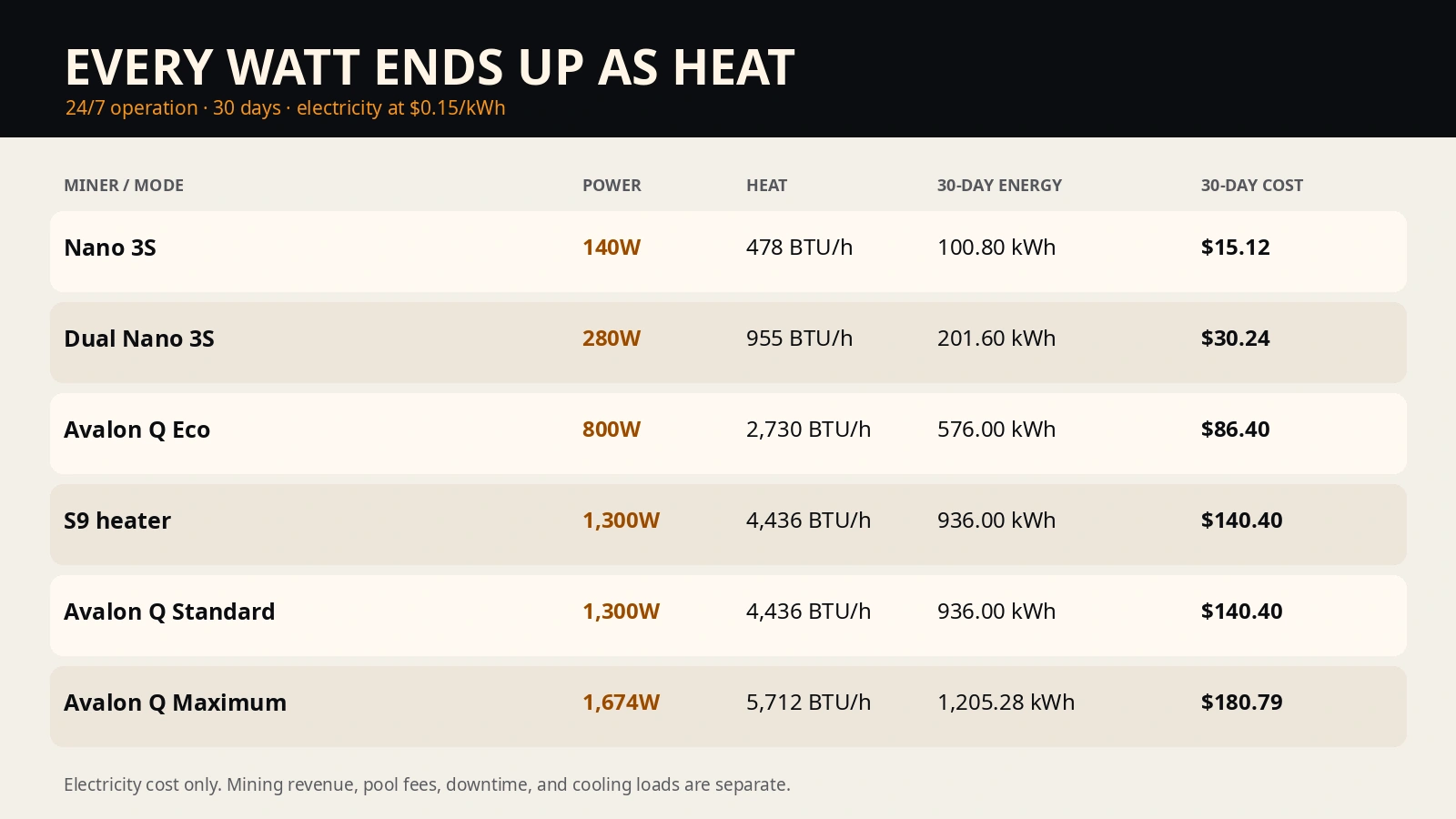
Bitcoin miner heat output and electricity cost
The table below assumes continuous 24/7 operation for 30 days at $0.15 per kWh. It calculates electricity cost only. It does not subtract mining revenue, add pool fees, predict Bitcoin price, or promise profitability.
| Miner or mode | Wall power | Heat output | Energy per 30 days | Cost at $0.15/kWh |
|---|---|---|---|---|
| Nano 3S | 140W | 478 BTU/h | 100.80 kWh | $15.12 |
| Two Nano 3S miners | 280W | 955 BTU/h | 201.60 kWh | $30.24 |
| Avalon Q Eco | 800W | 2,730 BTU/h | 576.00 kWh | $86.40 |
| S9 heater planning load | 1,300W | 4,436 BTU/h | 936.00 kWh | $140.40 |
| Avalon Q Standard | 1,300W | 4,436 BTU/h | 936.00 kWh | $140.40 |
| Avalon Q Maximum | 1,674W | 5,712 BTU/h | 1,205.28 kWh | $180.79 |
Planning values use current CryptoCloaks product specifications as verified August 29, 2026. Actual power varies with firmware, voltage, tuning, ambient temperature, silicon variation, fans, and power-supply efficiency. Measure your own unit when exact cost matters.
The S9 space-heater story: where the idea became a product
The Antminer S9 was designed as a mining appliance, not a living-room heater. Stock fans move a large amount of air through a narrow metal chassis, and the result sounds and feels industrial. But the machine was already releasing roughly 1,300W of heat. The waste was not the heat itself. The waste was letting that heat blast into an inconvenient corner with no control over noise, direction, or appearance.
The CryptoCloaks S9 Bitcoin Space Heater Case turned that problem into one of the shop’s defining builds. The current $149.99 case uses heat-resistant PETG, supports custom colors, and includes a 30-page build guide, two 140mm-to-120mm fan adapters, and four mounting screws. The included fan adapters help replace the stock high-RPM approach with larger fan hardware.
This conversion does not change the miner’s energy balance. A roughly 1,300W S9 remains a roughly 1,300W electrical load and heat source. The case changes how that load fits into a home: cleaner packaging, a deliberate airflow path, and a build process aimed at turning a loud industrial box into useful winter equipment.
What the S9 heater does well
- Produces room-scale heat from established, widely understood hardware.
- Turns a legacy miner into a purposeful winter project.
- Offers a replaceable, modifiable platform rather than a sealed appliance.
- Creates a strong heat-to-purchase-price ratio when an S9 is already available.
What it does not solve
- It does not reduce the miner’s electrical load.
- It does not make an S9 silent.
- It does not guarantee mining profit.
- It does not replace circuit, airflow, or fire-safety planning.
Modern Bitcoin miner space-heater options
The best modern choice depends less on the biggest hashrate number and more on how much heat the room can actually use. A small office may benefit from 140W. A basement or workshop may absorb 800W. A 1,674W maximum mode is a serious heating load that demands a serious electrical and ventilation plan.
Canaan Avalon Nano 3S: targeted desktop warmth
The Canaan Avalon Nano 3S runs at 6 TH/s and 140W. That is about 478 BTU/h, which is useful beside a desk but far below the output of a typical 1,500W portable space heater. Think of it as steady zone warming, not a whole-house furnace.
At the current $215 price, the Nano 3S includes its power supply and ships from Colorado. Its low draw makes placement easier than an S9 or Avalon Q, but the intake and exhaust still need open air. For two-miner setups, the 12 TH/s dual Nano 3S Cooler Box bundle combines two miners with fans, a controller, mounting hardware, and a ducting shroud for about 280W total.
Canaan Avalon Q: adjustable room-scale heat
The Canaan Avalon Q provides three practical heating levels: approximately 800W at 54 TH/s in Eco, 1,300W at 72 TH/s in Standard, and 1,674W at 90 TH/s in Maximum. That range lets one machine move from moderate shoulder-season heat to a substantial winter load.
The current $1,345 CryptoCloaks package includes a US power cord and one exact-fit 6-inch or 8-inch Avalon Q exhaust shroud. The shroud is already included with a new Avalon Q, so do not add the standalone $25 shroud unless you need an additional or replacement part.
Nano 3S Cooler Box: cleaner multi-miner airflow
The Canaan Nano 3 / Nano 3S Cooler Box is for two- or four-miner layouts. The package starts at $105 and includes the complete fan set for the selected capacity, a fan-speed controller, mounting hardware, cable management, and an exhaust shroud. It does not include the miners.
This is useful when several small miners create a messy set of competing air paths. The box gives the intake and exhaust a shared direction, making it easier to keep warm discharge away from the miner intakes and easier to attach seasonal ducting.
How to route mining heat in winter and summer
A miner does not care whether the room wants heat. It keeps moving energy from the outlet into the air. Your job is to decide where that hot air goes.
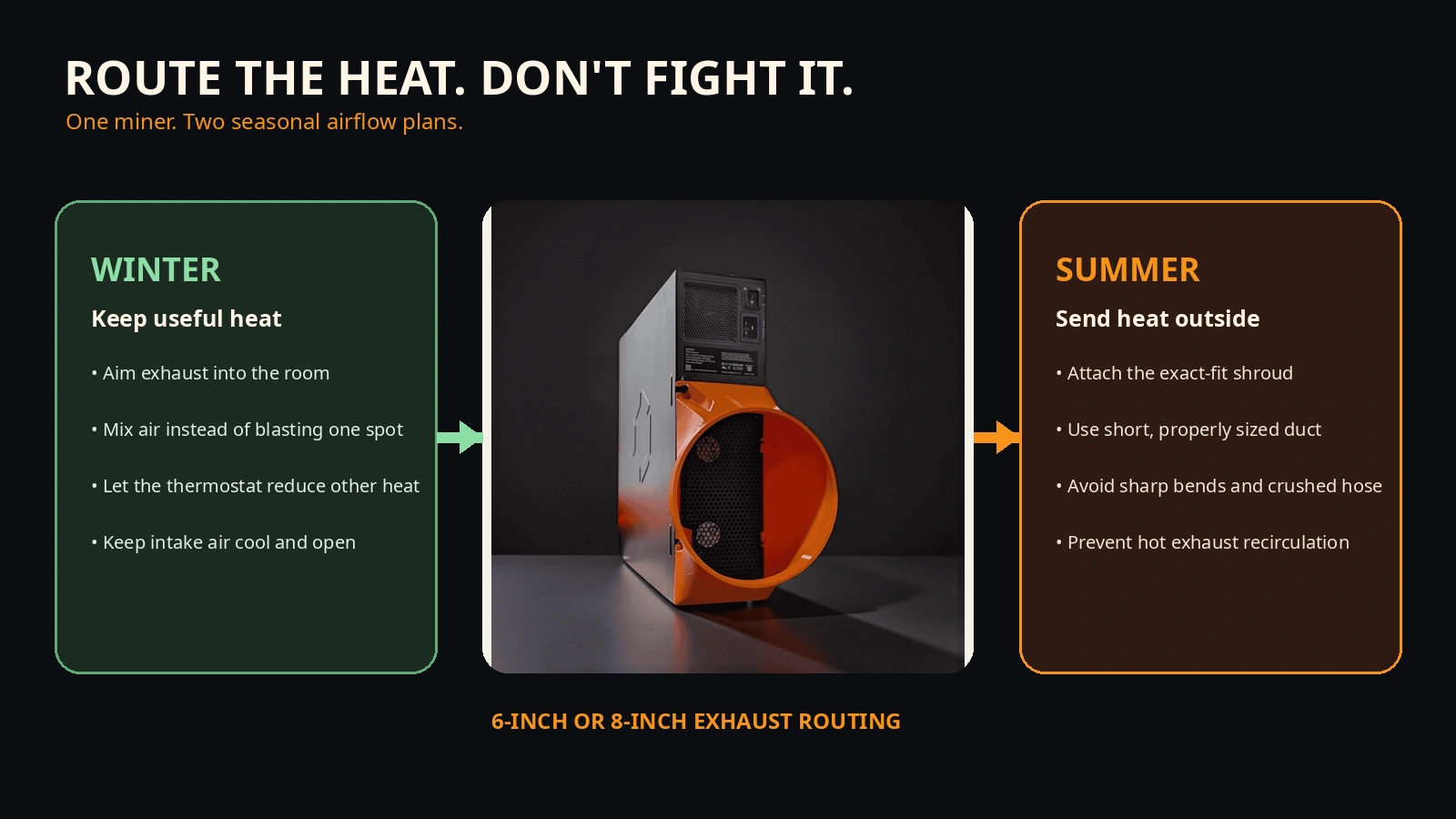
Winter: keep and mix the heat
- Place the intake in cooler room air. Do not point hot exhaust back toward the intake.
- Aim the exhaust into open space. Avoid blasting one wall, curtain, desk, or cable bundle.
- Mix the room air. A low-speed room fan can prevent a hot ceiling and a cold floor.
- Let the thermostat respond. The miner’s heat only displaces another heating load if the primary system actually runs less.
- Watch humidity and comfort. A miner adds sensible heat but no moisture, so winter air may still feel dry.
Summer: move the heat outside
- Use an exact-fit exhaust shroud. A loose adapter leaks hot air back into the room.
- Keep duct runs short. Long runs and sharp bends increase resistance and reduce airflow.
- Use the correct diameter. The Avalon Q shroud supports either 6-inch or 8-inch flexible duct; use the size selected for your installation.
- Prevent recirculation. Outdoor exhaust should not be pulled straight back through a nearby intake.
- Check backpressure and temperature. If a duct change raises miner temperature or fan speed, improve the route instead of forcing the setting.
Affiliate disclosure: As an Amazon Associate I earn from qualifying purchases.
The standalone Canaan Avalon Q exhaust shroud installs without tools and connects the rear exhaust to standard ducting. Again, one shroud is already included when purchasing a new Avalon Q from CryptoCloaks.
Bitcoin miner heater ROI: the honest math
“The heat is free” is wrong. “The mining is free because I needed heat” is also too simple. The honest comparison depends on what heat the miner actually replaces.
The useful comparison
Net cost of miner heat = electricity cost + mining fees and losses − mining value received
Then compare that result with the cost of the heating system that would otherwise have run.
If the alternative is an electric resistance heater, one kilowatt-hour used by the miner and one kilowatt-hour used by the heater produce roughly the same amount of heat in the room. The miner also performs work that may have value. That is the strongest economic case.
If the alternative is a modern heat pump, the miner usually loses on heating efficiency alone. A heat pump can move multiple units of heat indoors for each unit of electricity consumed. A miner produces roughly one unit of room heat per unit of electricity. Mining revenue may narrow the gap, but it does not change the physics.
If the alternative is natural gas, propane, wood, or district heat, compare actual local costs rather than assuming electrical heat is cheaper. Also account for whether the miner’s heat is needed all day. Heat produced after the thermostat is satisfied is not useful savings.
Mining revenue changes with network difficulty, Bitcoin price, pool rules, fees, uptime, and the miner’s measured hashrate. Solo mining is even more variable. Do not use a current daily revenue estimate as a permanent offset. For the probability side, read our Nano 3S home-mining reality check.
Electrical safety comes before hashrate
High-power equipment warning
The Avalon Q, Antminer S9, and similar miners are continuous high-power loads. Confirm that the receptacle, branch circuit, wiring, plug, power supply, and ventilation are appropriate for the selected mode. A plug fitting into a receptacle does not prove the circuit is suitable. Consult a licensed electrician when you are unsure.
- Measure at the wall. Use a properly rated meter and compare the result with the nameplate, product documentation, and circuit plan.
- Avoid overloaded shared circuits. A printer, vacuum, microwave, heater, or another miner on the same branch can push the total beyond a safe level.
- Do not use light-duty extension cords. Long, undersized, coiled, or damaged cords create voltage drop and heat.
- Keep combustibles away. Maintain open clearance around intakes, exhausts, power supplies, curtains, paper, filament, and stored boxes.
- Inspect connectors. Stop if a plug, receptacle, cable, or power-supply connector becomes discolored, loose, unusually hot, or damaged.
- Keep smoke detection current. A miner is unattended electrical equipment and deserves the same basic fire planning as any other continuous load.
- Start low and verify. Run the lowest practical mode first, observe wall power and temperature, then change one setting at a time.
At 120V, 1,300W is approximately 10.8A and 1,674W is approximately 14A before real-world voltage variation. Because mining is generally a continuous load, 1,674W exceeds the common 12A continuous-load limit of a 15A, 120V branch circuit. The included NEMA 5-15P plug does not make Maximum mode suitable for every NEMA 5-15 receptacle. Have a licensed electrician confirm the branch circuit and applicable code requirements.
Three practical Bitcoin miner heater setups
Small office
One Nano 3S
140W · 478 BTU/h
Place it near the occupied zone with clear intake and exhaust space. Expect gentle continuous warmth, not portable-heater output.
Workshop project
S9 heater conversion
About 1,300W · 4,436 BTU/h
Use the CryptoCloaks case and fan-adapter plan to turn legacy mining hardware into a deliberate room heater. Verify power and noise before choosing the room.
Adjustable room heat
Avalon Q
800–1,674W · 2,730–5,712 BTU/h
Begin in Eco, measure the circuit and room response, then use Standard or Maximum only when the electrical and ventilation plan supports it.
Common Bitcoin mining heater mistakes
- Buying for maximum hashrate instead of needed heat. Oversizing creates open windows in winter and air-conditioning load in summer.
- Treating projected mining revenue as fixed savings. Revenue changes; electricity cost and heat output are the controllable parts.
- Comparing a miner only with resistance heat. Heat pumps can provide more heat per kWh.
- Ducting without checking airflow. A badly routed hose can raise temperature and fan noise.
- Using indoor exhaust as intake air. Recirculation makes the miner cool itself with air it already heated.
- Ignoring the power supply. PSU heat and noise are part of the complete room experience.
- Running high power on an unknown circuit. Confirm the circuit before treating a maximum mode as a default.
- Forgetting summer. A winter asset becomes an unwanted cooling bill unless heat can be reduced or routed outside.
Which Bitcoin miner space heater should you choose?
| Your priority | Best starting point | Why |
|---|---|---|
| Low-power desktop mining | Nano 3S | 140W is easier to place and provides gentle zone heat. |
| Legacy DIY heater project | S9 Space Heater Case | Purpose-built conversion path for an existing S9. |
| Two compact miners with ducting | Dual Nano 3S bundle | 12 TH/s, about 280W, and a complete Cooler Box airflow package. |
| Adjustable room-scale heat | Avalon Q | Three modes span 800W to 1,674W, and a shroud is included. |
Bitcoin miner space heater FAQ
Does a Bitcoin miner produce the same heat as an electric heater?
At the same wall power and within the same room, both ultimately release roughly the same amount of heat. A miner also performs SHA-256 work. A heat pump is different because it moves additional heat into the room and can deliver more heat per kWh.
How many BTUs does a Bitcoin miner produce?
Multiply measured wall power by 3.412. A 140W Nano 3S produces about 478 BTU/h, a 1,300W miner about 4,436 BTU/h, and a 1,674W Avalon Q about 5,712 BTU/h.
Is Bitcoin mining heat free?
No. The heat is paid for through electricity. Mining revenue may offset part of that cost, but revenue varies with hashrate, network difficulty, Bitcoin price, pool terms, fees, and uptime.
Can a Nano 3S heat a room?
A Nano 3S adds 140W, or about 478 BTU/h. That can provide noticeable targeted warmth in a small office or near a desk, but it is far below a typical 1,500W portable heater.
Can an Antminer S9 be used as a space heater?
Yes. An S9 can produce roughly 1,300W of heat. The CryptoCloaks S9 Space Heater Case and fan-adapter system package that heat source for a home-oriented build, but they do not reduce its electrical requirements.
Does the Avalon Q include an exhaust shroud?
Yes. The current CryptoCloaks Avalon Q package includes one exact-fit 6-inch or 8-inch exhaust shroud. Buy the standalone shroud only when you need an additional or replacement part.
Should I duct miner heat outside?
Usually in warm weather. Use a correctly sized exact-fit shroud, a short duct route, gentle bends, and an outlet location that prevents exhaust recirculation. Check temperature and fan behavior after changing the route.
Is a miner cheaper than a heat pump?
Usually not on heating efficiency alone. A heat pump can move multiple units of heat for each unit of electricity. A miner produces roughly one unit of room heat per unit of electricity, with possible mining value as a separate offset.
What electricity rate should I use for mining-heater math?
Use the all-in marginal rate from your bill, including energy charges that increase with each additional kWh. If time-of-use pricing applies, calculate the hours separately instead of using one blended number.
What is the safest first step?
Identify the planned branch circuit and its existing loads, read the miner and power-supply documentation, begin with the lowest practical operating mode, and consult a licensed electrician if the receptacle, wiring, breaker, or continuous-load capacity is uncertain.
Final verdict
A Bitcoin miner space heater makes sense when you need the heat, can safely supply the power, and can use or route the airflow. The physics are straightforward: the wall power becomes room heat. The economics are conditional: mining value can offset electricity cost, but it never turns a poor electrical or seasonal setup into a good one.
For targeted desk heat, start with the 140W Nano 3S. For a hands-on legacy build, the S9 Space Heater Case remains the original CryptoCloaks answer. For adjustable room-scale output, the Avalon Q provides the widest useful range and includes the shroud needed to control its exhaust.